Our day started very early as one of the priestesses in the ashram began her morning with bells and prayers around 5:00 AM. Slowly everyone stirred, and soon we were up and about. We hadn’t been able to see much of the ashram at night, but it turned out to be quite big and clean, with multiple temples and a cowshed. It had bathrooms and toilets that we were able to use to freshen up in the morning. I had a quick bath, and by then some of our group had set up a chool to prepare tea and breakfast—today, it was Maggi noodles.


There was a small-sized tempo/truck arranged to take us to our next stop today. We loaded all our bags and then all managed to fit in as well, in various states of standing and sitting. We drove through the Gautala Autramghat Wildlife Sanctuary to Patna and dropped off our bags at one of the stalls near the temple.


Our vehicle dropped us off on the main road near the Maheshwar Mahadev Temple, an ancient masterpiece of Hemadpanthi architecture.


From here, we started our climb towards Kanhergad. The plan was to see some of the famous caves as we made our way to the top.


Our first stop was the Nagarjun Jain Caves, an ancient rock-cut cave featuring a prominent seated statue of Bhagvan Mahavir.


We saw the Sita Nhani Leni next. Local folklore associates this rock-cut chamber with the Ramayana trail, identifying it as a place where Mata Sita spent time during her exile.


We hiked further up, and from one point, we could see the Hemadpanthi Maheshwar Mahadev Temple where we had started.


Our next stop was Shrungar Chavadi, a rock-cut cave temple with a structured porch.


Climbing further, we had to ascend a steep set of stone steps, but a metal railing had been installed for support.


Even after crossing this, there was still more to go. We could see the flag right at the top of the fort, and that was where we had to reach.


Right at the top, there was a hanuman mandir, and some locals had gathered there since it was Saturday. They gave us prasad and also made tea for all of us. We could see the Chandika Devi Mandir down in the valley and the Pitalkhora Buddhist Caves on the hills on the other side. It seemed hard to believe that this was our next destination and that we had to get there before sunset today. Pedka Fort was also visible in the distance. We sat there for some time and had snacks that some members of our group had carried along.


We were able to see the entrance to the fort from one of the vantage points at the top. Our initial plan was to descend via an alternative route to see it up close, but there were some tricky rock patches along the way. Eventually, only our group leader, who had crossed the first patch, continued along that route, while the rest of us returned the way we had come.


The walk down was easier, and we were able to make it back to the Hemadpanthi Maheshwar Mahadev Temple at the base fairly quickly.


We then made our way towards the Chandika Devi Mandir through the Gautala Autramghat Wildlife Sanctuary, staying in the shade of the trees as much as possible.


We stopped at a small snack stall near the temple, enjoyed some oli bhel and matki bhel, and relaxed for a bit. The area where the stalls were set up was surrounded by tall trees with monkeys eyeing looking for opportunities to get something to eat.

After this, we had to hike up to the Pitalkhora Buddhist Caves carrying all our bags. This was our first ascent of the trip with full luggage—on our two major climbs so far (Rajdeher Fort yesterday and Kanhergad today), we had left our heavy packs at the base. Because we were not returning to the base after visiting the caves, carrying everything with us was the only option. Everyone felt a bit apprehensive, but setting our doubts aside, we started off. We made a quick visit to the Chandika Devi Mandir and then set out along the path to the top.


The climb went through the trees for a while, shielding us from the harsh direct sun, but the heat and humidity made the ascent quite demanding.
Everyone kept moving at their own pace, and our group leader along with several others made sure no one was left walking alone.


I was part of the lead group that reached the top, and the Pitalkhora Buddhist Caves were truly impressive. They felt reminiscent of the Ajanta Caves, though on a much smaller scale. The evening light gave the entire complex a warm, beautiful glow.


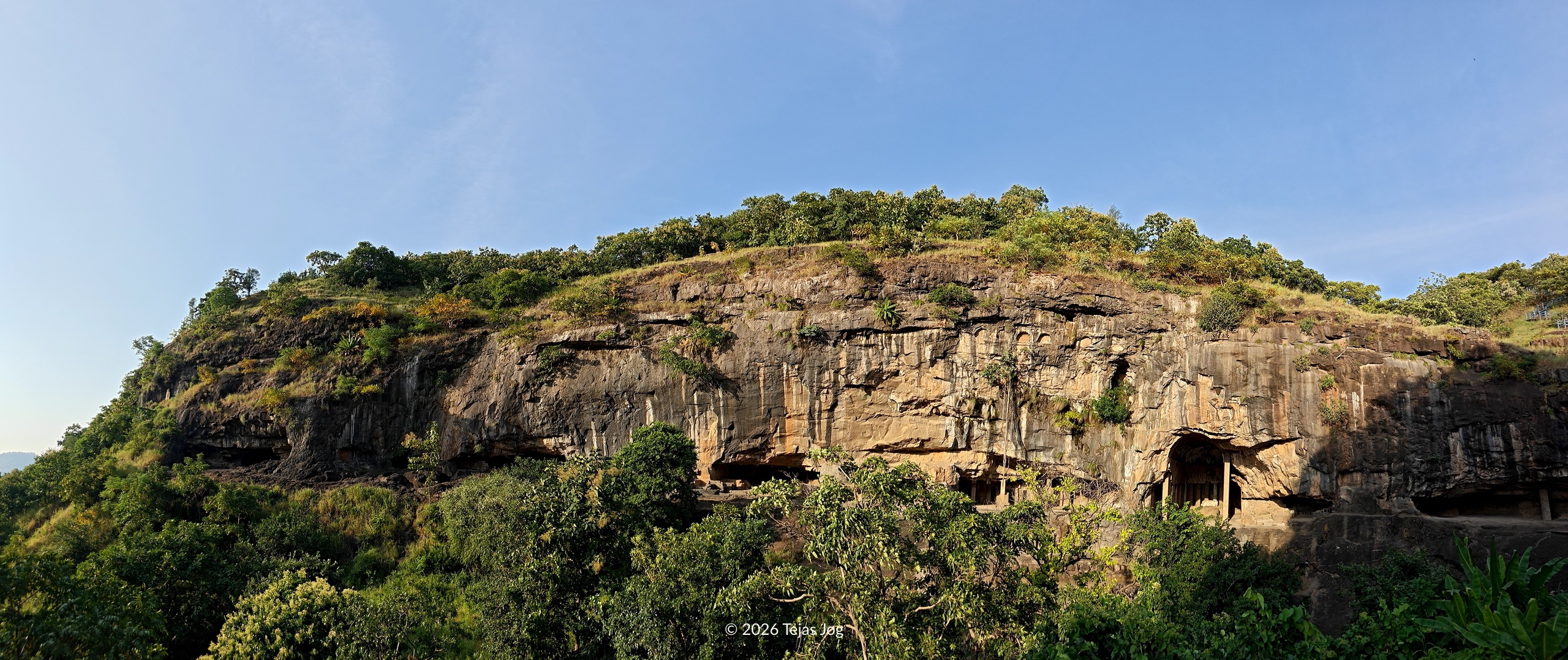


Once all of us reached the top, everyone was happy that we had made it with all our stuff, and the mood became light and relaxed. We got more chirpy and noisy, but suddenly one of the staff members said that the bees had become agitated (not sure whether it was because of us or something else) and asked everyone to stay still and keep quiet. Soon, the bees settled down, and as it was also getting dark, we decided to move on.
We continued climbing up to the main road at the top to reach our next stop. We went up the stone stairs we had spotted earlier and soon reached the gate of the Gautala Autramghat Wildlife Sanctuary.


The plateau at the top had a small settlement surrounded by farms, including fields of bajri (pearl millet). The grain on the cob did indeed look like pearls. Our plan was to reach Amba Tada village and then figure out how to get to Pedak Wadi. As we walked along the main road, a local resident asked where we were headed and offered to arrange a vehicle for us. I called out to our group leader, and we got it sorted. While waiting for the ride to arrive, we did some yoga and light stretching to unwind after the long hike. We managed to fit everyone into the vehicle, with all our luggage tied securely on top. Everyone was in high spirits after making the climb, and we enjoyed classic 80s and 90s Bollywood songs as we drove towards Pedak Wadi.


One of the staff members stationed at the Pitalkhora Buddhist Caves mentioned that his house was right along our route and insisted that we drop in for tea. We spent some time there, met his family, and shared a cup of tea. Once again, I was impressed by the warmth and hospitality of the rural folk.


Continuing on, we arrived at the place where we originally planned to spend the night, but the shed was far too small to accommodate all of us, and the owners advised against sleeping outdoors. We headed back to Pedak Wadi, where a local villager generously offered us the terrace of his home. It was so kind of him to open his home to 14 strangers without any hesitation. I wondered how we would react if 14 unknown people suddenly turned up at our door asking to stay the night.


We carried our gear up to the terrace, and our host family kindly let us use their kitchen to cook dinner. The menu was soup followed by khichadi, kurdaya, and thecha. We self-organized into small prep teams and got cooking. After the initial preparation, we realized that the portion of khichadi was too large, so we set aside part of it for breakfast the next morning and cooked the rest for dinner. We enjoyed the meal together, and afterwards, headed up to the terrace. Everyone set up their mats and sleeping bags, settling in for the night under the open sky in the cool air and bright moonlight.