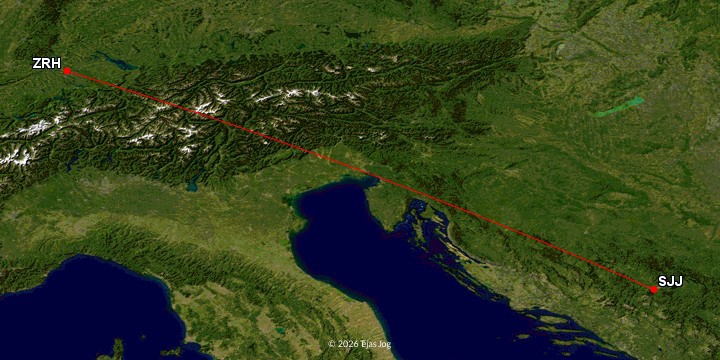
I had already checked in for my flight to Sarajevo, so upon reaching Zurich Airport, I cleared security and was able to access the Marhaba Lounge in the main terminal with my Priority Pass.


There weren’t too many people around, and I was able to grab a quick bite to eat before the flight.


My flight LX1450 was scheduled to depart from the D gates (which are below the B gates), and I had to clear immigration to get there. We were taken to the aircraft by bus and boarded via stairs.


We got a nice view of Zurich Airport, Zurich city, and Lake Zurich as we turned around after take-off and headed southeast. The flight itself was uneventful, and the green hills and mountains welcomed us to Sarajevo.


Immigration was fairly quick, and I was able to enter visa-free on the basis of my valid Schengen visa. I exchanged money at one of the counters in the arrivals hall and found that the exchange rate was fair.


After exiting the airport, I walked to the Dobrinja škola bus stop and took trolleybus 103 to Trg Austrije.


After reaching Trg Austrije, I walked the short distance to see the Latin Bridge, a historic Ottoman-era stone-arch bridge spanning the Miljacka River.


I then walked along the river to see the #Sarajevo sign across from Sarajevo City Hall, the most iconic landmark of the Austro-Hungarian era.


From here, I walked across to Baščaršija, the Ottoman-era old bazaar and the historical heart of Sarajevo. Right at the center of the main market square is Sebilj, an iconic 18th-century wooden Ottoman-style kiosk fountain.


The Baščaršija Mosque, known for its perfectly proportioned, classical Ottoman sub-domed design, is also called the Havadže Durak Mosque. Kazandžiluk is an alley famous for its traditional handcrafted, ornate copperware made by local artisans.


My next stop was the Gazi Husrev-beg Mosque, the largest historical mosque in Bosnia and Herzegovina. It is recognized as the most significant Ottoman-era structure in the Balkans. The beautiful, roofed Šadrvan (ablution fountain) sits at the center of the front courtyard.


Walking further, I reached the Sarajevo Meeting of Cultures marker, which serves as the precise line where Ottoman (Eastern) and Austro-Hungarian (Western) influences meet from an architectural, cultural, and historical perspective.


My next stop was the Sacred Heart Cathedral, the largest Catholic cathedral in Bosnia and Herzegovina. Outside the main entrance is a large monument dedicated to Pope John Paul II.


A little ahead was the Orthodox Church of the Nativity of the Theotokos, the largest Serbian Orthodox church in Sarajevo and one of the grandest in the entire Balkan region.


I saw The Multicultural Man, a bronze open-air sculpture located in Liberation Park. The park also features bronze memorial busts honoring prominent Bosnian writers and poets, including Ivo Andrić and Meša Selimović.


I then crossed over to the south bank of the Miljacka River to see the Ashkenazi Synagogue, the only active synagogue in Sarajevo. This completed the landmarks that earned Sarajevo the title “Jerusalem of Europe”.


I looked up places for lunch that served local food and decided to go to Besame Mucho. I had the Bosnian Dolma based on their recommendation.


After lunch, I walked around Baščaršija, then towards Gradska vijećnica Sarajevo, and eventually returned to Trg Austrije to take trolleybus 103 to Trolejbuska okretaljka Dobrinja, before walking to Autobuska Stanica Istočno Sarajevo.


I had booked a Kondor Bus from Sarajevo to Belgrade on obilet.com. Once I reached Autobuska Stanica Istočno Sarajevo, I showed my ticket at the counter and paid a platform fee. The bus arrived, and I was able to get a single seat for myself on the right side.


We left on time, and our bus drove through some smaller towns like Sokolac to pick up and drop off passengers. The Bosnian countryside rolled by, and we made a rest stop just before Han Pijesak.


We also got a nice view of the Church of the Holy Trinity as we drove through Vlasenica. After crossing Drinjača, we drove along the Drina River and saw the Russian Church on the hill across the river in Sakar, Serbia.


We reached the border crossing in Karakaj on the Bosnian side. Everyone had to get off the bus and queue up to have their documents checked. Then we boarded the bus and crossed the New Bridge to reach the Mali Zvornik border crossing on the Serbian side.
In Serbia, an officer collected everyone’s documents and returned them after some time. My passport was stamped for exit from Bosnia, but not for entry into Serbia. I was a little worried about that because border control might ask how I entered the country when leaving Serbia the next day, but I had the exit stamp from Bosnia and the bus ticket as proof of travel.

The drive through Serbia was quicker, and we reached the New Belgrade Bus Station at night. It took me a while to find the stop for bus 9A, but I eventually found it and boarded. I got off at Zeleni venac and started walking down Kraljice Natalije.
I met my wife at Teraziye Terrace Park, and then we walked to Zavičaj Balkanska for dinner. However, it was late and they had stopped taking food orders, so we quickly hopped across the road to Tutto Bene, which was still open.


We ordered a vegetarian pizza; it was freshly prepared and didn’t take too long. We walked back to Villa Terazije after dinner and called it a night.
🍽️ Marhaba Lounge
✈️ SWISS 1450
🚍 Bus 103 to Trg Austrije
🍽️ Besame Mucho
🚍 Bus 103 to Trolejbuska okretaljka Dobrinja
🚍 Kondor Bus
🍽️ Tutto Bene
🛏️ Villa Terazije